

Rents Hit 18-Year High in Tokyo as Japan's Office Market Defies Gravity
By Michael Gerrity, World Property Journal on October 28, 2025 8:59 AM


Japan's office market tightened further in the third quarter of 2025, with vacancies falling in half of the nation's major cities and rents climbing to record levels, according to a new report by CBRE. The data underscores a broad recovery in office demand across Japan's regional markets, led by strong absorption in Yokohama, Fukuoka, and Tokyo.
Vacancy Rates Decline Across Major Markets
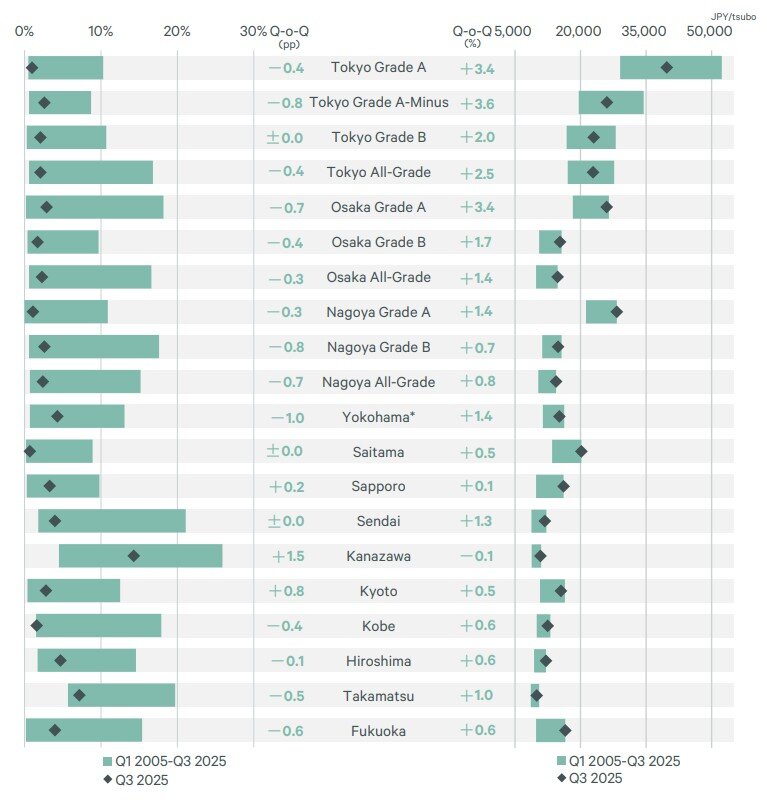
CBRE reported that all-grade office vacancies declined quarter-over-quarter in five of the 10 cities surveyed, held steady in two, and rose in three. Yokohama once again posted the sharpest improvement, as its vacancy rate dropped by one percentage point to 4.3%. The decline was driven by relocations from company-owned properties and steady demand for expansion and new office openings.
Fukuoka followed with a 0.6-point drop to 4.0%, supported by several relocations into larger spaces exceeding 100 tsubo. Many tenants were moving temporarily to accommodate building redevelopments, while others upgraded or expanded operations--signs, CBRE said, of resilient underlying demand.
Among cities where vacancies increased, new supply was the main factor. Sapporo saw about 3,000 tsubo of new space enter the market, lifting vacancies slightly by 0.2 points, even as tenants continued upgrading into existing prime stock. Kanazawa recorded a 1.5-point increase as new supply equivalent to 3% of existing inventory exceeded take-up. In Kyoto, limited new supply opened fully leased, but downsizing and consolidations elsewhere caused vacancies to rise by 0.8 points.
Rents Climb in Nearly Every Market
Office rents rose in nine of the 10 surveyed cities, continuing a nationwide uptrend. Only Kanazawa posted a marginal decline. Yokohama, Sendai, and Takamatsu saw rents jump more than 1% quarter-over-quarter--the strongest gains in years. For Yokohama and Sendai, it marked their first such increases since early 2020 and late 2019, respectively.
Landlords lifted rents around Yokohama Station and Kannai, while in Sendai, newer high-grade buildings with little vacancy commanded higher rates. CBRE noted that "almost no properties reported lower rents nationwide," with Sapporo, Saitama, and Hiroshima each setting new record highs.
Tokyo Tightens Further as Rents Surge to 18-Year High
Tokyo's office market remains exceptionally tight. The all-grade vacancy rate fell 0.4 points to 2.1%, while Grade A vacancies dropped to just 1.0%. Strong tenant demand for limited large-floor plates pushed Grade A rents up 3.4% to approximately $1,075 per tsubo--marking the sharpest quarterly rise since 2007 and surpassing the pre-pandemic peak of about $1,055 set in Q1 2020.
"Tokyo's premium space is now commanding its highest rents in nearly two decades," CBRE said, noting that competition for top-tier buildings in central wards remains fierce.
Osaka and Nagoya Set New Records
In Osaka, vacancies slipped 0.3 points to 2.3% as existing buildings filled steadily. Average all-grade rents climbed 1.4% to roughly $400 per tsubo--an all-time high. Grade A landlords in both the Umeda district and secondary areas implemented across-the-board increases.
Nagoya also saw record highs, with the all-grade vacancy rate dropping 0.7 points to 2.4%, its lowest since mid-2021. Grade A rents rose 1.4% to about $765, while all-grade rents gained 0.8% to $390, the highest levels since CBRE began its survey.
Market Outlook
CBRE said Japan's office markets continue to demonstrate "remarkable stability," supported by solid tenant demand, limited speculative construction, and expansion-driven relocations. While new supply in some secondary cities may briefly lift vacancies, overall fundamentals remain robust heading into 2026, particularly in Tokyo and other major metropolitan hubs.

No Offer of Securities—Disclosure of Interests: Under no circumstances should any material at this site be used or considered as an offer to sell or a solicitation of any offer to buy an interest in any investment. Any such offer or solicitation will be made only by means of the Confidential Private Offering Memorandum relating to the particular investment. Access to information about the investments are limited to investors who either qualify as accredited investors within the meaning of the Securities Act of 1933, as amended, or those investors who generally are sophisticated in financial matters, such that they are capable of evaluating the merits and risks of prospective investments. This site not intended for use as a source of legal, tax, or accounting advice. Any link, site, book, video, article, podcast, illustration, person, or reference to the aforementioned is not an endorsement nor an endorsement of Midas Holdings, Inc. or this site. All forms of financial investment pose some inherent risks. Midas Holdings, Inc. and the publisher of this site are not engaged in rendering professional services, and you should consult a professional, licensed certified public accountant and an attorney specialized in SEC laws where appropriate since federal, state, and local laws constantly change and laws can be different in each state or local municipalities. Each transaction and individual circumstances vary widely and participants are strongly urged to seek independent legal, tax, financial advisor, and professional advice. Prior to investing in private equity real estate or real estate syndications, individuals must determine if they are qualified to take part in the investment process. Those who are qualified will want to explore their personal investment objectives, liquidity requirements, and tolerance for risk in the real estate markets.(Review all the terms, conditions, notices, and disclaimers by clicking on this Disclaimer.)
© 2017-2023 Midas Holdings, Inc. All Rights Reserved. Disclaimer